Between 2010 and 2020, the global steel industry underwent a transformative decade—driven not by slogans or carbon accounting, but by metallurgical competition. It was a golden age of technical rivalry between established producers in Europe and fast-rising giants in Asia, notably China and South Korea.
The battle was on UHSS (Ultra High Strength Steel), multiphase grades, hot-stamped boron steels, and HSLA (High Strength Low Alloy) solutions. The automotive and white goods industries were at the forefront, pushing the limits of mechanical resistance, formability, crashworthiness, and light-weighting. The overall objective was clear: make structures lighter, without compromising performance. And lighter meant stronger—hence the race toward steels with higher tensile strength and optimized microstructures. There were precise benchmarks: elongation, yield ratio, tensile strength, hole expansion, bendability. Every steel mill knew what the targets were—and invested accordingly.
In those years, China’s Baosteel was pushing aggressively into DP (Dual Phase) and CP (Complex Phase) steels. POSCO in Korea was mastering TWIP (Twinning Induced Plasticity) and advanced martensitic grades. Europe—especially ArcelorMittal—defended its leadership by innovating both in metallurgy and customer integration.
One emblematic strategy was the “locking” of customers through grade branding and on-site engineering. ArcelorMittal’s Fortiform® and Usibor® steels weren’t just metallurgical products—they were platforms, complete with technical support. Engineers were stationed at OEM plants, adjusting the customer’s press lines to be finely tuned to the steel’s thermal and forming characteristics. This “lock-in” created an entry barrier: switching supplier would mean recalibrating entire lines. It was fair competition—based on performance, not certificates. It was not market manipulation; it was deep industrial partnership.
This kind of technical race meant a Chinese or Korean mill couldn’t simply offer a cheaper steel—it had to offer a better one. And many of them did. That was healthy. That was industrial progress.
But then came the ideological turn.
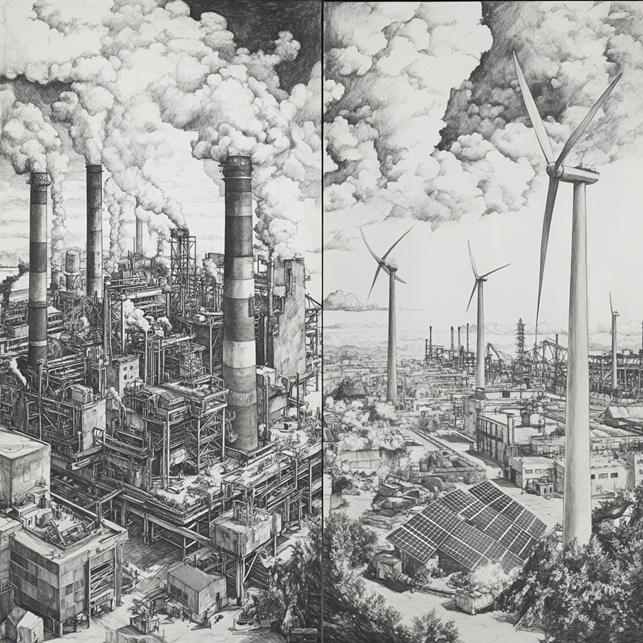
From 2018 onwards, the conversation began shifting. Climate goals became industrial dogma. The Green Deal, CBAM (Carbon Border Adjustment Mechanism), SBTi (Science Based Targets initiative), and taxonomy regulations emerged. The narrative moved from “what can your steel do?” to “how green is your steel?”—measured not in MPa or elongation, but in CO₂-equivalent per ton.
Suddenly, the product was no longer the focus—the process was. Steelmakers turned inward, replacing R&D budgets with ESG reporting teams. Blast furnaces became villains. EAFs (Electric Arc Furnaces) became saints. Hydrogen was proclaimed the redeemer. Everything had to be electric: cars, furnaces, scooters—even when the electricity grid was powered by coal.
The results are visible, and bitter. In automotive steel, the trend towards light-weighting was reversed. EVs (Electric Vehicles) require large battery packs, often adding 200–400 kg of weight. The design trade-off shifted from crash performance to battery placement. And the most ironic aspect? Many of these vehicles still emit more lifetime CO₂ when charged with fossil-fuel electricity than a modern ICE (Internal Combustion Engine) car using lightweight UHSS chassis.
Meanwhile, LCA (Life Cycle Assessment) data—when it’s actually used correctly—shows massive inconsistencies. The difference between BOF (Basic Oxygen Furnace) and EAF steel in terms of CO₂ footprint depends heavily on scrap quality and grid mix. A Swedish “green” EAF using hydroelectric power and 100% scrap is not the same as an Indian EAF running on coal-based electricity. But the green labels look the same.
Technological development has slowed. Since 2020, the launch of new multiphase steels has been minimal. Instead, companies race to publish decarbonization roadmaps. Tata Steel’s IJmuiden plant, for instance, once known for its metallurgical innovation, is now in a €3B transition plan to eliminate its blast furnaces by 2030. Salzgitter AG’s “SALCOS” project (Salzgitter Low CO₂ Steelmaking) is similarly transforming one of Europe’s most technically rich production hubs into a “green steel” site—with a projected 95% CO₂ reduction. Laudable? Perhaps. But the opportunity cost in terms of R&D is severe.
The market dynamics are shifting accordingly. Green steel premiums are beginning to emerge, with some buyers—like Volvo Cars or Mercedes-Benz—pledging to use fossil-free steel. But this is a minority. For the bulk of OEMs, price remains king. The actual volume of fossil-free steel sold in 2024 remains negligible: SSAB, one of the most advanced in this area, reported only a few thousand tons of HYBRIT-based steel produced so far—against an annual steel production in the EU of over 150 million tons.
What’s lost is not just competitiveness. It’s know-how. Engineers who spent a decade mastering stamping curves, grain refinement, ferrite-bainite transitions, and complex annealing lines are now retrained to handle Scope 3 emissions reporting. Entire departments are dismantled. The steel industry, once the foundation of mechanical civilization, is being reshaped into a passive actor in the sustainability circus.
This is not a nostalgic lament. It’s a call for rebalancing. We are not against green steel. But it must not be built at the expense of the metallurgical progress that took decades to achieve. The industry must not become a supplier of certificates instead of materials.
Because if innovation becomes synonymous with electrification, and progress means only “less CO₂,” then we have not advanced. We’ve retreated.
Luigi Villani is the
owner of GTG Consulting and specializes in analyzing industrial trends in
materials science. For more insights, visit www.gtgcons.com.





Leave a Reply