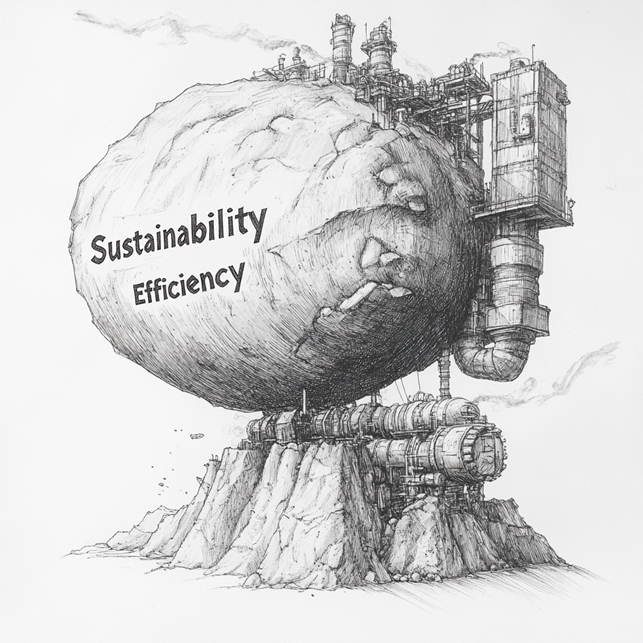
In contemporary industrial strategy, the word “sustainability” carries considerable weight politically, legally, and reputationally. It defines much of the external pressure that corporations face today. But in strictly technical and operational terms, sustainability targets are imposed conditions. They do not arise from within a plant’s process optimization logic, nor do they typically correlate with immediate operational improvements.
By contrast, energy efficiency is an internally-driven metric. It is tangible, cost-effective, and measurable. It enables decarbonization without eroding competitiveness, and it delivers sustainability as a secondary outcome—rather than as a primary constraint. In a high-cost energy environment, efficiency is not only a technical necessity; it is the cornerstone of industrial autonomy.
Sustainability: A Regulatory Overlay
Sustainability objectives often begin as policy. For instance, the European Union’s Green Deal, the Carbon Border Adjustment Mechanism (CBAM), and the expansion of the EU Emissions Trading System (EU ETS) define a regulatory framework rather than an engineering solution. Under EU ETS Phase IV (2021–2030), free emission allowances are being progressively reduced. By 2025, many large industrial players will face a situation where CO₂ costs are no longer marginal but core to their operating models.
For example, SSAB, the Nordic steel producer, reported €256 million in ETS-related costs in 2023, representing over 5% of its total OPEX. These compliance expenditures do not improve plant performance or product quality. They are externalized costs that must be absorbed—unless the company transforms its internal processes.
Energy Efficiency: A Thermodynamic Imperative
While sustainability operates as an external mandate, energy efficiency is grounded in physical and economic logic. Every reduction in energy input per unit of product reduces emissions, lowers variable costs, and improves system resilience. Efficiency delivers benefits even in the absence of carbon pricing.
Consider the case of thyssenkrupp Rasselstein, a packaging steel plant in Andernach, Germany—the largest of its kind in Europe. In 2021, thyssenkrupp invested in a full revamp of its continuous annealing and pickling line, incorporating state-of-the-art recuperative burners, variable-speed drives, and intelligent process control systems. The result was a 22% reduction in natural gas consumption and a 19% decrease in CO₂ emissions. Simultaneously, line speed was increased by 8%, improving throughput without expanding the plant’s footprint.
This was not a “green” investment in the political sense. It was a thermodynamic optimization of an energy-intensive process. Yet it delivered precisely the kind of outcomes regulators seek: lower emissions, lower energy demand, and higher productivity.
Global Data on Efficiency Gains
According to the IEA (Energy Efficiency 2023), global efficiency improvements between 2000 and 2022 have prevented over 15 Gt of CO₂ emissions—equivalent to nearly half of China’s total emissions during that period. In 2022 alone, global final energy intensity improved by 2.2%, more than double the average from 2015 to 2019.
McKinsey analysis shows that investments in industrial energy efficiency offer negative marginal abatement costs in more than 60% of scenarios meaning they are profitable even without carbon pricing or subsidies. Waste heat recovery systems, improved process insulation, high-efficiency motors, and advanced control systems all deliver returns within 2–5 years.
Case Study: Buzzi Unicem – Vernasca Cement Plant
At Buzzi Unicem’s cement plant in Vernasca, Italy, a comprehensive energy efficiency program was launched in 2018. The project involved the installation of a low-temperature waste heat recovery (WHR) system integrated with a high-efficiency Organic Rankine Cycle (ORC) generator, producing up to 7 MW of electricity from kiln exhaust gases.
This initiative enabled the plant to self-generate 20% of its electricity needs, reducing grid dependency and avoiding approximately 30,000 tonnes of CO₂ annually. More importantly, it reduced specific electricity consumption per tonne of clinker by 14%, enhancing the site’s cost position in a highly competitive sector.
This intervention was categorized as an “energy optimization project,” not a sustainability program. Yet its decarbonization effect exceeded many direct carbon offset investments made in the sector over the same period.
Why Efficiency Remains Undervalue
Despite its tangible benefits, energy efficiency remains underprioritized in ESG strategies. This is due in part to how emissions are reported. Scope 1 and Scope 2 disclosures often capture absolute emissions but not the relative gains achieved through efficiency measures unless accompanied by visible technological shifts.
As a result, a company investing €10 million in advanced heat integration may achieve a higher emissions reduction per euro than one investing €100 million in hydrogen pilot plants but the latter receives more ESG visibility and regulatory attention.
The Illusion of Green Transformation Without Efficiency
In materials science and process engineering, no sustainability transformation is possible without a foundation in energy efficiency. Any carbon reduction that does not begin with minimizing energy input per functional output is thermodynamically flawed.
Hydrogen-based direct reduction, carbon capture, and bio-based feedstocks all assume a baseline of optimized processes. If a plant continues to operate with outdated burners, oversized motors, or suboptimal heat exchange systems, adding decarbonization technology simply masks inefficiency at a higher cost.
This is particularly critical in the glass and ceramic industries, where furnace thermal efficiency can vary from 30% to 80% depending on the level of recuperation and insulation. In these sectors, efficiency determines not just emissions, but product consistency, yield, and batch stability.
Engineering Freedom Through Efficiency
When an industrial operator improves its energy efficiency, it increases its degrees of freedom: to operate under fluctuating energy prices, to reduce dependency on external energy inputs, and to reinvest savings into further process innovation.
Sustainability, meanwhile, imposes boundaries. It defines what must be achieved, not how. Energy efficiency defines how better performance is physically and economically possible.
The key insight is this: sustainability is an outcome, not a process. Only when industrial systems are driven by efficiency from the ground up does sustainability become structurally viable.
Luigi Villani is the owner of GTG Consulting and specializes in analyzing industrial trends in materials science. For more insights, visit www.gtgcons.com.





Leave a Reply