The conversation around sustainability often frames electrification as a “green” solution while labeling combustion as inherently “black” or harmful. The general consensus seems to suggest that switching to electric power for processes across industries will automatically reduce emissions and curb global warming. However, this binary view oversimplifies the issue. In reality, not all electrification is sustainable, and in some cases, combustion-based processes—if executed with advanced technologies—can be more environmentally friendly than their electric counterparts.
This misconception is particularly relevant in heavy industries such as steelmaking, where the race towards electrification may not always lead to the most sustainable outcomes.
The Assumptions Behind “Green Electrification”
The core assumption of the electrification narrative is that it relies on renewable energy sources such as wind, solar, or hydroelectric power. However, as of today, the global energy grid is far from being fully renewable. According to the International Energy Agency (IEA), fossil fuels still account for nearly 60% of global electricity generation. This means that a shift to electric-powered processes often relies on electricity produced from coal, natural gas, or other non-renewable resources.
Take the example of electric vehicles (EVs). While they are celebrated as a greener alternative to internal combustion engine (ICE) cars, their life cycle carbon footprint heavily depends on how the electricity used to charge them is generated. A study from the University of Michigan found that in regions where coal still dominates power generation, the total emissions of an EV can surpass those of a high-efficiency gasoline vehicle.
The same principle holds for industrial processes, particularly in sectors like steel, where energy intensity and efficiency are crucial.
The Case of Steelmaking: Can Combustion Be “Greener”?
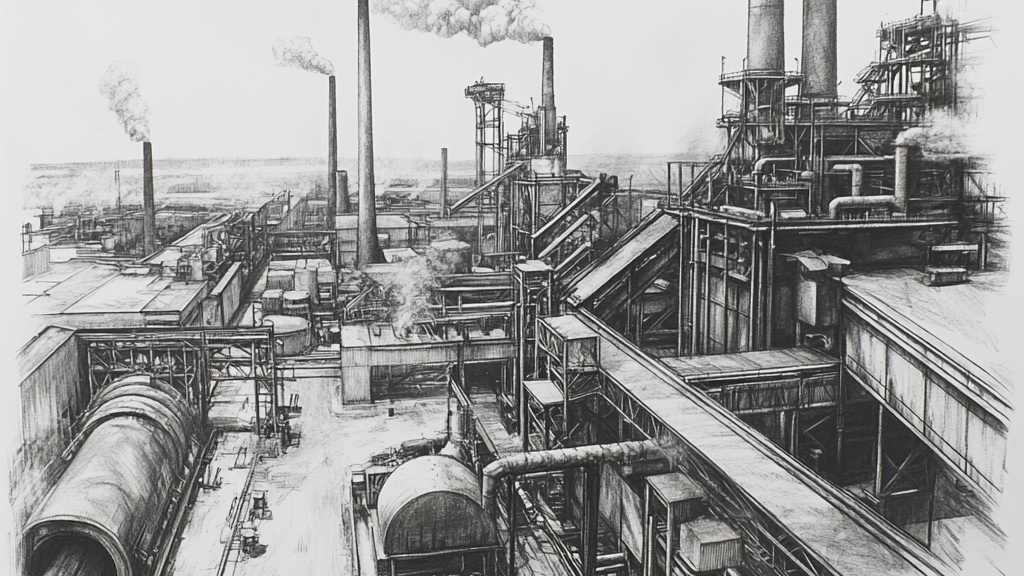
Steel production, one of the most energy-intensive industries globally, provides an excellent case study. The industry currently relies heavily on two major production routes: the blast furnace-basic oxygen furnace (BF-BOF) method, which primarily uses coke and coal, and the electric arc furnace (EAF) method, which relies on electricity to melt scrap steel or direct reduced iron (DRI).
It is tempting to assume that EAFs are inherently greener than BF-BOFs due to their reliance on electricity rather than coal. However, the sustainability of EAFs depends largely on the energy mix of the region in which they operate. In countries like China, where coal is still a dominant energy source, the carbon intensity of steel produced using EAFs can rival or exceed that of BF-BOF steel production.
Case Study: Electric Arc Furnaces in Poland
Poland, a country where coal represents nearly 70% of the energy mix, offers a striking example. An EAF operating in Poland will, in fact, emit more CO₂ per tonne of steel produced compared to a modern BF-BOF system. A study conducted by the Polish Academy of Sciences indicated that a blast furnace combined with advanced carbon capture technologies (like the Tata Steel plant in Ijmuiden, the Netherlands) could outperform EAFs in terms of emissions reduction.
Thus, under certain conditions, an efficient combustion-based process can indeed be “greener” than an electrified alternative. Moreover, the implementation of new technologies in combustion systems, such as oxy-fuel combustion or hydrogen injection in blast furnaces, can further improve the sustainability of traditional methods.
Technological Innovation in Combustion: A Sustainable Alternative?
Technological advances in combustion are rapidly changing the equation. Take the example of hydrogen-based combustion, which is now emerging as a cleaner alternative for steelmaking. Companies like SSAB, LKAB, and Vattenfall are spearheading the HYBRIT initiative, aimed at replacing coke with hydrogen in the iron reduction process, potentially making steel production fossil-free.
Similarly, technologies such as oxy-fuel combustion can significantly reduce CO₂ emissions in industries like cement, glass, and steel. By using pure oxygen instead of air, oxy-fuel combustion dramatically reduces the amount of nitrogen in the combustion chamber, leading to higher efficiency and lower greenhouse gas emissions. This method is already being piloted by companies like ArcelorMittal at their steel plants in Ghent, Belgium.
On the other hand, if we look at the electrification of industrial heat, it often requires large-scale energy storage systems, which are highly inefficient and prone to energy losses. Not to mention the resource-intensity of producing the required infrastructure, including high-capacity batteries and electric grid expansion, which has its own environmental footprint.
The Carbon Footprint of Electrification Infrastructure
Another often overlooked aspect of the electrification debate is the carbon footprint of building the necessary infrastructure. The production of electric grids, batteries, and electric vehicle charging stations involves the mining and processing of raw materials such as lithium, cobalt, and nickel, which have their own environmental and social consequences.
For example, battery production is a highly energy-intensive process. A study by IVL, the Swedish Environmental Research Institute, found that the production of a typical EV battery emits between 150-200 kg of CO₂ per kWh of battery capacity. For a 100 kWh battery—the size used in many modern electric vehicles—this translates to around 15-20 tonnes of CO₂ before the vehicle has even been driven.
This raises an important question: is electrification, with all its associated infrastructure, always the most sustainable option?
A Balanced Approach to Sustainability
Sustainability should not be reduced to a simplistic dichotomy of “electric equals green” and “combustion equals black.” Instead, each process should be evaluated on a case-by-case basis, considering the full life cycle emissions, energy source mix, and potential for technological innovation.
The key to reducing industrial emissions may lie not in blindly following the electrification path but in optimizing processes—whether electric or combustion-based—by leveraging the latest technological advances and improving energy efficiency.
In the steel industry, both electric arc furnaces and blast furnaces have their place, depending on regional energy sources and the availability of sustainable technologies. In some cases, combustion with advanced carbon capture or hydrogen integration may even be more environmentally friendly than electrification.
By broadening our view of sustainability, we can avoid the pitfalls of electrification absolutism and instead focus on pragmatic, evidence-based solutions that balance energy efficiency, emissions reduction, and economic feasibility.






Leave a Reply